


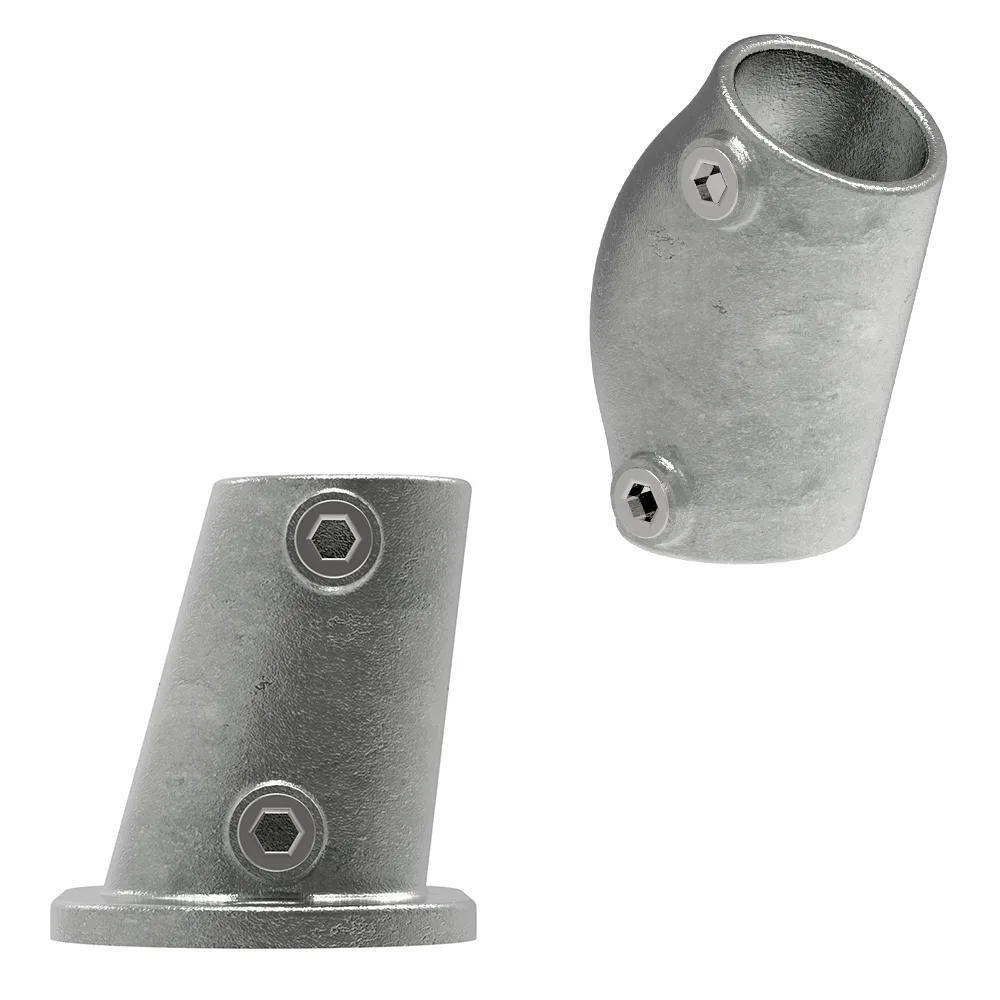


 pipe connector
 Stainless steel components
 wrought iron
 Grating steps
 Grating
 Marine | Boat accessories
 Sliding gate fittings
 Sealing plugs and protective caps

Quality standards & acceptance criteria: Galvanising residues on hot-dip galvanised gratings
Transparency in incoming goods inspection:
What is permissible in terms of zinc flakes and zinc skins resulting from the production process – and when a defect is present.
During the hot-dip galvanising of gratings (particularly in the case of fine-mesh designs such as MW 30/10 mm), it is physically impossible to completely avoid production-related zinc flakes or zinc skins in the mesh openings. To ensure clarity for customers, suppliers and the goods-in inspection team, our binding quality specification QV-GR-01 precisely defines the permissible tolerances.
Why do zinc residues form?
Hot-dip galvanising is carried out in accordance with DIN EN ISO 1461, whilst grating is manufactured in accordance with DIN 24537 (with dimensional and shape tolerances in accordance with RAL-GZ 638). Whilst these standards require a surface finish suitable for the intended use, they do not specify any percentage limits for mesh openings. Due to physical factors, fine-mesh gratings (e.g. with a mesh size of 30/10 mm) are more prone to individual meshes becoming clogged with zinc flakes or thin zinc films when immersed in the zinc bath. Our specification provides a reliable and fair benchmark in this regard.
A direct comparison of the two performance classes
Details of standard galvanising (our quality specification)
For a standard order, goods falling within the following tolerances are considered technically sound and do not constitute a material defect:
- At least 90 per cent of the total mesh area must be completely open.
- A maximum of 2 per cent of all meshes may be completely closed.
- A maximum of 3 meshes may be closed immediately adjacent to one another.
- Functionality: Water drainage, air permeability, slip resistance and safe walkability must not be compromised under any circumstances.
- Important: Loose, sharp-edged or breakable zinc projections are never permitted under any circumstances.
Important note: If you require a finish that is completely free of zinc flakes for your project, please select our premium galvanising with manual finishing before placing your order.
This will be quoted separately.
How testing is carried out: The testing and assessment procedure
The assessment is carried out visually in normal daylight and from a standard viewing distance (microscopic effects or purely colour deviations/dullness of the zinc coating are excluded).
To assess partial coverage, we use the transparent reference mesh model:
- Fully covered = 1.00
- Approx. 75 per cent covered = 0.75
- Half (50 per cent) covered = 0.50
- Approx. 25 per cent covered = 0.25


What does not constitute grounds for a complaint?
In accordance with technical standards, the following visual characteristics do not constitute grounds for a complaint:
-
Colour variations, mattness, spotting or dark discolouration of the zinc coating.
-
White rust caused by transport or storage when exposed to moisture.
-
Zinc protrusions outside the opening area (provided this does not affect installability and there is no risk of injury).
-
Dimensional and shape tolerances (the RAL-GZ 638 quality assurance standard applies here).
Complaints & efficient handling
In accordance with Section 377 of the German Commercial Code (HGB), the goods must be inspected immediately upon receipt. To ensure that any complaint can be dealt with quickly and efficiently, we require the following details from you:
-
Order or delivery
note number -
Item and exact mesh size
(e.g. MW 30/10 mm)
-
Number of affected gratings (please specify the exact quantity)
-
Photo 1 (overview): The entire grating photographed
vertically in daylight -
Photo 2 (detail): The affected area with a folding rule or scale
placed against it -
Count:
Brief description of the blocked or partially covered mesh openings in the test area
Following inspection, should a valid defect be found, you will receive a replacement or professional rectification from FeNau GmbH as soon as possible.
Rechtlicher Status: Diese Qualitätsvorgabe konkretisiert die beschaffene Ware im Sinne des § 434 BGB, sofern darauf in Angeboten, AGB oder Auftragsbestätigungen Bezug genommen wird.
FeNau GmbH · Veit-Stoß-Straße 20 · 90579 Langenzenn
(Freigegeben durch Th. Nautsch, Geschäftsführung)